DOCSIS,CMTS Headends, Cable Television, IT, HDTV, IPTV, FTTH, FIOS. Tablets, mobele phones, Android.
Panasonic and Verizon: Full HD 3D Video Over Verizon's FiOS
Full-resolution high-definition 3D transmission via a premium TV service provider became a reality at this year's 2011 International Consumer Electronics Show. Verizon and Panasonic, a leader in Full HD 3D technology, are streaming Full HD 3D, currently the highest-possible resolution of 3D video, via Verizon's 100 percent fiber-optic FiOS TV service.
Full HD 3D transmissions preserve the complete 1080p picture resolution that consumers have come to expect from their HDTVs. Other solutions degrade the 3D image, typically reducing resolution by half. In a demonstration at the Verizon-sponsored Blogger Lounge, FiOS engineers showed a selection of 3D content streaming to a Panasonic Full HD Blu-ray 3D Disc™ player at a bit rate of up to 18 Mbps (megabits per second) -- double the bit rate currently used by most cable providers.
Verizon’s TV Everywhere strategy a “triple play to the triple screen”
Live TV Is Coming to the iPad
lightreading.com
Verizon Stops Reporting Video Subscriber Counts
via ipdemocracy.com
Verizon issued its Q2 08 earnings earning results this morning and although the company's wireless business helped propel Verizon to strong net income growth, its customer wireline business -- including video and broadband, heretofore growth stalwarts -- seems to be, um, in the toilet.
One clear sign that something is wrong with a product line at any given company is when the company ceases to report statistics on that particular product. Starting with Q2 08, Verizon is no longer reporting total video subscribers -- nada, zip, zilch. At the end of Q1 08, Verizon served a total of 2.154 million video subscribers, but we don't know how many total video customers Verizon served at the end of Q2 08 because the number is nowhere to be found in its investor reports.
Verizon investor spokesoman Ron Lataille confirmed for me that the company no longer gives out this number. That's a good indication that Verizon lost a boatload of DBS customers under its pact with DirecTV during the quarter. At the end of Q1 08, Verizon had nearly a million, or 948,000, DirecTV customers.
Verizon did report its FiOS TV subscriber count, and here again the news wasn't good. During the quarter, Verizon added 176,000 net new FiOS TV customers to reach a total of 1.382 million subscribers by quarter's end. But the 176,000 net adds represents a steep drop from the 263,000 net adds during Q1 08 and is the first time the telco hasn't posted accelerating growth in this service category.

During the earnings call, Verizon President Denny Strigl defended the weak FiOS TV growth numbers saying that they "were about what we had expected." He said FiOS TV growth is already picking up in the third quarter and should continue to make gains throughout the year, thanks in large part to its launch of service today in New York City.
Surprisingly, not one analyst on the call asked Verizon about its DBS service subscriber count. Verizon, like fellow telco AT&T, is banking on video growth from its own network-based services and has viewed its DBS partnership as a stop-gap measure to gain market share as cable makes inroads into the voice business. Still, it's likely that Verizon posted a net loss in video subscribers during the quarter, with the loss in DBS customers outweighing the tepid gain in FiOS TV customers.
Verizon's broadband business didn't fare that much better. During the quarter, Verizon added only 54,000 net new broadband customers, just one-fifth of the broadband net gains added during the previous quarter and the year-ago quarter.

Although Verizon's FiOS high-speed service added a net 187,000 new customers during the quarter, Verizon lost 133,000 DSL customers -- presumably many of these switched over to the superior FiOS broadband option. By quarter's end, Verizon served 8.33 million broadband customers.
Combined with a loss of 92,000 access lines, these losses paint a pretty grim picture for the company's wireline business. During the earnings call, Strigl said that despite these weak results, the recession didn't seem to be causing problems for Verizon, at least not in terms of the bottom-line. "Although we are seeing some softening in the volumes, we do not expect any significant impact on our financial results for the rest of the year," he said.
The still-booming wireless business is the pole holding up Verizon's tent. During the quarter, Verizon added 1.5 million net new customers, up from the 1.3 million added during Q2 07 and on par with Q1 08 levels, even in the face of stiff competition with AT&T's iPhone. By quarter's end, Verizon served 68.68 million wireless customers.
Net income rose to $1.88 billion for the quarter, up from $1.68 billion during the year-ago quarter, as revenues ticked up from $23.27 billion to $24.12 billion.
Verizon’s FiOS
Verizon’s FiOS TV had 943k subscribers at the end of 2007, making it the third largest IPTV provider after France Telecom and PCCW. IPTV has been a part of Verizon FiOS TV service since its launch in 2005. FiOS TV utilizes a hybrid QAM / IP platform that uses QAM RF to deliver broadcast channel programming and IPTV to deliver video on-demand content. The middleware is largely proprietary with certain elements inherited from Microsoft. The set top box is sourced from Motorola. An innovate aspect of Verizon’s FiOS TV service is the two-part realization of the whole-home media concept, something that no other (major) IPTV provider or MSO currently offers. Part one is “Home Media DVR” service, a multi-room DVR solution that is delivered by the IP-based FiOS in-home LAN and its IP-enabled STBs. It allows a customer to view different DVR-stored programs on up to three STB-connected TVs (DVR STB + 2 remote terminal STBs) simultaneously in their home with trick-play control and the ability to pause a program in one room and resume watching it in another room. Currently this service delivers SD streams to the two remote terminal STBs but Verizon has disclosed its near-term plans to add HD streaming to Home Media DVR in 1H08.
Part Two is “Media Manager” a software application bundled (at no additional charge) with Home Media DVR. This application allows users to enjoy photo and music files stored on LAN-connected computers on their STB-connected TV, audio system or home theater.
Verizon's FiOS Internet and TV service has the potential to be a threat to cable broadband service providers. The main appeal of FiOS is a fiber optic line directly to the home. Mid-tier service produces 15 Mbps download speeds. The rub: Installation for Verizon can be pricey for the telecom giant as contractors have to lay a fiber optic conduit directly to the home. Here's the step-by-step installation for ZDNet's Larry Dignan. More on the FiOS experience can be found on Between the Lines. First step (beyond the initial phone call of course) was to install a conduit for the fiber optic line to the home. In my neighborhood, all power and phone lines are buried so laying the line required some digging.

some photos from ZDNet: Verizon FiOS installation step by step


Each fiber-optic hub serves 12 homes. Each house has a connection once the fiber-optic lines are run through the conduits (orange tubes). These run under the street to my house. I'll be the second house in the 12 homes served by this hub to get FiOS. Each house has its own line.
This is the box that is attached to the house to connect the fiber-optic line with Verizon's central office. This box is made by Tellabs, a telecom equipment maker.
Download speeds thus far hover around 15 mbps with the spike here and there. Speed test conducted at Speakeasy.net.Bright Forecast for 2008: Cable and Telcos to Continue Battling
The competition between cable and telephone companies continues to accelerate, and business and residential users continue to be the big winners. While this is not a new trend, it is comforting to see that it is in full force in the new year.
Verizon said this week that it has more than doubled the speed of its digital subscriber line (DSL) service to 7 Mbps at 400 locations in the United States, and that the increased throughput will be available nationwide by the end of the year. The goal, this Philly.com story says, is to increase interest in DSL to combat cable gains.
Verizon DSL sales had fallen off a cliff, dropping from 301,000 in the third quarter of 2006 to just 56,000 during the third quarter of this year. Part of that drop can be attributed to the transition of many customers to the company’s faster FiOS fiber service, of course. The company apparently figures that there is enough of a market at the lower end of the speed spectrum to have two distinctly different broadband product families.
Perhaps the most striking example of how the deck chairs have been rearranged during the past decade is the fact that Comcast now says that it is the fourth largest telephone service provider in the United States. Wired describes the CES keynote delivered on Tuesday by CEO Brian Roberts. The next iteration of the industry’s Cable over Data Service Interface Specifications, DOCSIS 3.0, will be available in some markets by year’s end. The story details innovations planned by the company, including ultra fast movie downloads and Tru2Way, an open access cable converter. The company will embed the circuitry into many devices, the story says. Necessity — in the form of innovation — apparently truly is the mother of invention.
This is an interesting look at how the telcos are gearing up for competition from an analyst with PDS Consulting. The writer says that Verizon is importing executives that have “marketing-oriented, hyper-competitive” attitudes from the its wireless arm. Likewise, AT&T’s merger with BellSouth has given the company more control over the wireless company, formerly called Cingular, that had been owned by the two before the merger. The post ends with examples of aggressive bundling initiatives from each company.
Not surprisingly, analysts find that the competition is leading to increased spending and more expansive services. This In-Stat press release hypes a study that says 90 percent of cable systems now offer high-definition television. This, the commentary says, likely was driven by the “stiff competition” offered by telco and satellite video services. The firm found that 84 percent of systems offer 750 MHz or more of bandwidth, OpenCable Application Platform (OCAP)-based set top boxes are beginning to be deployed and that 42 percent of cable television subscribers also subscribe to broadband services.
The reason for the desire to engage its customer base is is clear: The survey found that 54 percent of the cable systems said that the telephone company was offering service somewhere in their footprints. The release didn’t describe the average size of the telco offerings within their service area. Regardless, the fact that there are telco competitors in more than half of the operators’ areas is extraordinary.
The scrutiny that the competition causes is clear in this Telecosm post. Ike Elliott says that Verizon and AT&T won the battle in 2007. The two telcos’ stock price rose more than 15 percent, while Comcast’s was down 35 percent — perhaps the driver of Roberts’ service announcements at CES — and Charter performed at an even lower rate. The reasons are simple: Cable is losing video customers and its broadband progress is middling. Its success in voice, the writer says, is not enough to offset these twin sources of bad news.
itbusinessedge.comAlso Read These Articles
Wall St. connects with telcos and cable
![]() |
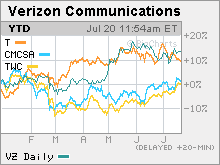
| Shares of Baby Bells Verizon and AT&T have outperformed the stocks of the top two cable companies so far this year. |
Source:Thomson Financial |
Shares of Dow components AT&T (Charts, Fortune 500) and Verizon (Charts, Fortune 500) are up 11 percent and 13.5 percent this year while shares of the top two cable firms, Comcast (Charts) and Time Warner Cable (Charts), which is a majority owned subsidiary of CNNMoney.com's parent company Time Warner (Charts, Fortune 500), have gained just 3 percent and 1 percent respectively. Time Warner Cable began trading as a separate stock on a so-called "when issued" basis in January and made its formal debut in early March.
With all four companies set to report their latest financial results in the next two weeks, will the telecoms continue to outperform cablers?
AT&T, Comcast and Time Warner Cable are all expected to post robust gains in profits and earnings for the second quarter but a lot of this growth is driven by acquisitions.
Ma Bell, which will report its second quarter results on July 24, completed its purchase of BellSouth in December. Comcast and Time Warner Cable teamed up in a deal to split up the assets of bankrupt cable provider Adelphia Communications earlier this year. Comcast's earnings are due out on July 26 while Time Warner Cable will report its results on August 1.
Verizon, however, is expected to report an earnings decline of 3 percent and revenue increase of just 1.3 percent for the second quarter. It will release its results on July 30.
The stock did get a lift recently due to speculation that British telecom Vodafone, which is a minority owner in Verizon Wireless, was considering a takeover of Verizon. Vodafone has denied the rumors.
Despite the sluggish growth projection for Verizon, Cowen & Co. analyst Thomas Watts is predicting solid results in this quarter and the next few quarters for Verizon on other metrics.
In a recent research note, he thinks the company is doing a good job of getting customers to sign up for newer services, most notably its FiOS video product that competes most directly with cable.
"[Verizon is] focused on transforming its revenue to include a greater proportion of higher growth services, such as wireless, broadband, and video, and a decreasing percentage from traditional telephony," Watts wrote in his report.
Watts also wrote that AT&T should benefit in the second quarter from healthy increases in digital subscriber line (DSL) Internet access customers as well as strong demand for AT&T's wireless services.
Although sales of Apple's (Charts, Fortune 500) iPhone, which AT&T is the exclusive carrier for in the U.S., won't have a huge impact on second quarter sales since the phone was released just days before the quarter ended, Watts wrote that AT&T may have added as many as 200,000 new subscribers in the quarter due to the iPhone and that this bodes well for the rest of the year.
money.cnn.com